
api.ast.linalg#
Functions#
|
|
|
|
|
|
Classes#
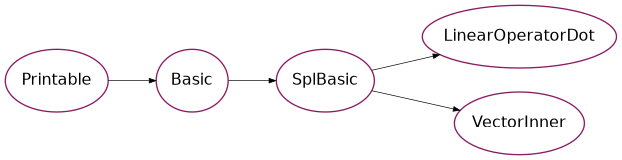
|
Generate the Matrix Vector Product function for a BlockLinearOperator,StencilMatrix or StencilInterfaceMatrix. |
|
Details#
- class LinearOperatorDot(ndim, block_shape, comm=None, **kwargs)[source]#
Bases:
SplBasicGenerate the Matrix Vector Product function for a BlockLinearOperator,StencilMatrix or StencilInterfaceMatrix. In case of a BlockLinearOperator we give the number of blocks along the rows and columns specified with the block_shape. In case of StencilMatrix or StencilInterfaceMatrix the block_shape = (1,1).
- Parameters:
- ndimint
Number of dimensions.
- block_shape: tuple of ints
The number of blocks along the rows and columns.
- comm: MPI.Comm
MPI intra-communicator.
- property func#
The top-level function in an expression.
The following should hold for all objects:
>> x == x.func(*x.args)
Examples
>>> from sympy.abc import x
>>> a = 2*x
>>> a.func
<class 'sympy.core.mul.Mul'>
>>> a.args
(2, x)
>>> a.func(*a.args)
2*x
>>> a == a.func(*a.args)
True
- property arguments#
- property code#
- property folder#
- default_assumptions = {}#
- class VectorInner(ndim, backend=None)[source]#
Bases:
SplBasic- property ndim#
- property func#
The top-level function in an expression.
The following should hold for all objects:
>> x == x.func(*x.args)
Examples
>>> from sympy.abc import x
>>> a = 2*x
>>> a.func
<class 'sympy.core.mul.Mul'>
>>> a.args
(2, x)
>>> a.func(*a.args)
2*x
>>> a == a.func(*a.args)
True
- property backend#
- default_assumptions = {}#